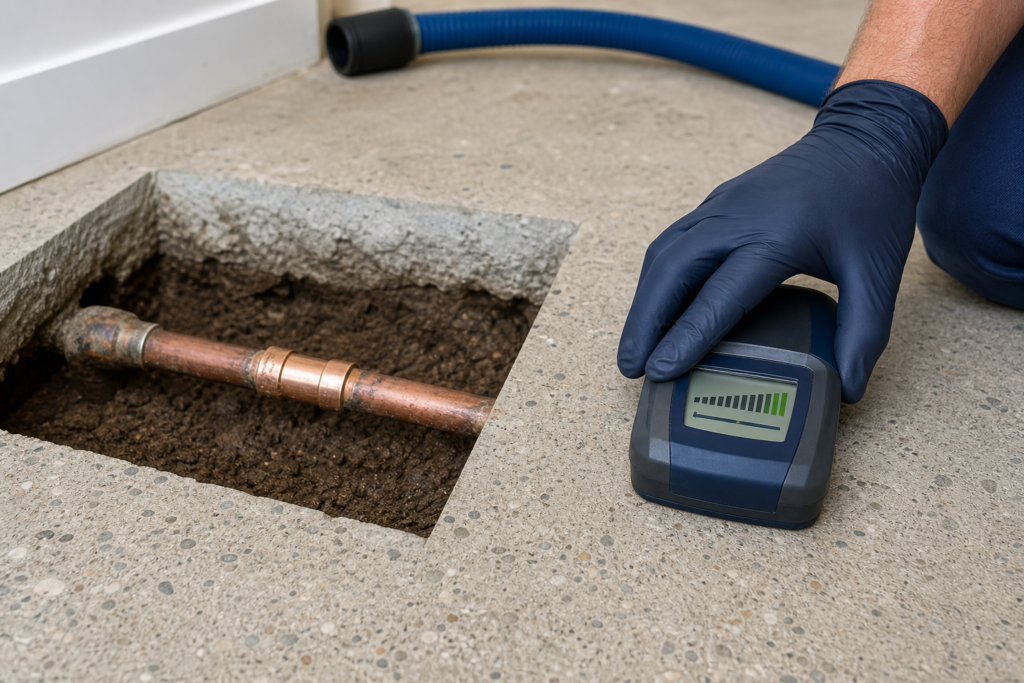





A concrete slab is not proven dry because the surface looks lighter, feels dry, or has been exposed for a certain number of days. First, the plumbing leak must be stopped. Then the affected concrete has to be mapped and checked with methods appropriate to the slab and the flooring that will cover it. Readings should show that the wet pattern is resolving and that the planned floor or coating can be installed under its required conditions.
There is no single moisture number or drying time that fits every slab. Concrete composition, leak volume, floor covering, adhesive, vapor barrier, indoor conditions, and the chosen test method all affect the decision.
Why a Concrete Surface Can Look Dry Too Soon
Concrete contains a network of pores. Water can move into those pores and spread beyond the obvious puddle. The exposed surface may dry first because air reaches it, while moisture remains deeper in the slab or beneath flooring that was not removed.
A clean-water supply leak may also travel along joints, cracks, pipe penetrations, adhesive beds, or the boundary between the slab and a wall. The visible edge of damage does not always mark the full affected area.
Floor coverings change the drying pattern. Sheet vinyl and some coatings can limit evaporation. Wood, laminate, and resilient flooring can absorb moisture or trap it against the slab. Tile may remain attached while water affects the setting material, grout, or nearby finishes. Carpet and pad can dry differently from the concrete underneath.
Touching one open spot cannot describe all those conditions. A reliable assessment looks for a pattern across the affected and surrounding areas.
Confirm That the Plumbing Source Is Stopped
Drying cannot be verified while water is still entering the concrete. The failed pipe, fitting, valve, fixture connection, appliance line, or drain condition should be repaired and checked under the conditions that produced the leak.
Watch for water returning after the plumbing is pressurized or a nearby fixture operates. Continued meter movement, pressure loss, a recurring damp edge, or a running-water sound may justify more leak isolation. Those clues do not locate the source by themselves.
If the loss began with a buried or main supply line, professional water line repair and replacement may be needed before restoration can proceed. Keep the plumbing repair record with the drying documentation so the source and the affected materials are not treated as separate, unconnected problems.
Do not cover an access opening or reinstall flooring until the repair has been checked and the moisture assessment no longer shows renewed wetting.
Start With a Moisture Map
A restoration technician can begin by screening the slab in a grid or another repeatable pattern. Readings are taken across the visibly affected area, beyond its edges, and in comparable concrete that appears unaffected. The goal is to understand the boundary and monitor how it changes.
Non-invasive meters can help identify relative differences without drilling into the slab. They are useful for screening, but their displayed value is not a universal concrete moisture percentage. Concrete density, salts, coatings, embedded reinforcing or utilities, surface contamination, temperature, and device design can influence the response.
That is why one high reading does not automatically prove a hidden leak, and one low reading does not prove the entire slab is ready. The useful evidence is a consistent pattern, appropriate comparison areas, and repeated observations that move in the expected direction.
Photographs or diagrams should identify where readings were taken. If the same points are checked later, the drying trend is easier to evaluate than a collection of numbers with no locations.
Concrete-Focused Tests May Be Needed Before Flooring
A handheld scan can map likely wet areas, but a flooring decision may call for a concrete-focused test selected by the responsible restoration or flooring professional. Different methods assess different conditions, and their results are not interchangeable.
The appropriate method depends on factors such as:
- The slab construction and thickness
- Whether the concrete is on grade or above another space
- The suspected direction and duration of water movement
- Existing coatings, adhesive, tile, or other materials
- The new flooring and adhesive system
- The product manufacturer’s installation requirements
- The locations that can be tested without creating a hazard
Some project specifications may use measurements taken within the slab. Others may rely on a surface-emission method, comparative readings, or a combination of inspection and monitoring. A homeowner should not drill test holes or improvise a test. Embedded pipes, reinforcing steel, electrical conduit, and other utilities may be present.
Ask which method was used, what part of the concrete it evaluates, and what acceptance criteria apply to the exact flooring system. A test result only has meaning when it is interpreted under the method and project conditions for which it was taken.
The Planned Floor Changes the Answer
“Dry enough” is not a stand-alone condition. The slab must be suitable for what will be installed over it.
A flooring installer may need to consider the floor product, underlayment, adhesive, coating, and vapor-control system together. Installing a low-permeance finish too soon can trap moisture. That may contribute to adhesive failure, bubbles, discoloration, odor, lifted flooring, damaged wood products, or moisture moving toward walls and trim.
Tile, engineered wood, solid wood, laminate, carpet, sheet vinyl, luxury vinyl, and epoxy coatings do not share one installation rule. Even products within the same category can have different requirements. The restoration team can document the moisture condition, while the installer or product specification determines what the chosen system accepts.
If the old floor remains partially in place, its condition should also be evaluated. A dry exposed strip does not prove that concrete beneath an adhered or impermeable section matches it.
Drying Time Is Evidence Only When Paired With Readings
Two slabs exposed to similar-looking leaks may dry at different rates. Water volume, exposure time, concrete density, slab thickness, vapor conditions below the slab, indoor humidity, temperature, airflow, floor removal, and drying equipment all matter.
The calendar shows how long drying has been underway. It does not show whether moisture remains in the concrete. A fixed promise of one, three, or seven days can be misleading when it is not tied to material evidence.
Drying progress is stronger when:
- The plumbing source remains stopped
- The mapped wet boundary becomes smaller or less elevated
- Repeated readings at documented points move toward appropriate comparisons
- Adjacent flooring, baseboards, and walls do not show renewed moisture
- Indoor conditions support the drying plan
- The final assessment addresses the exact finish that will be installed
Equipment should be adjusted or removed by the responsible technician. Turning it off because the room feels comfortable can interrupt a plan that is based on conditions inside the slab rather than the room surface.
Check Nearby Walls and Flooring Separately
Water on a slab often reaches more than concrete. Drywall, insulation, lower wall plates, cabinets, flooring, and adhesive may retain moisture differently. A slab result cannot be used as proof that those materials are ready.
If water reached a wall, the source, cavity, framing, insulation, and finish need their own evaluation. The same principle applies to checking whether walls are dry after a plumbing leak: the visible face is only one part of the assembly.
Likewise, damaged flooring may need inspection for swelling, separation, staining, odor, or loss of bond. Do not force up adhered material or cut into an assembly to look underneath. Controlled removal may require attention to utilities, dust, suspect materials, and the water source category.
Clean Water and Contaminated Water Require Different Decisions
A supply-line leak and a sewage backup are not the same restoration condition. Water from a toilet overflow, sewer line, or other contaminated source may require material removal, cleaning, containment, and personal-protection decisions beyond drying.
Do not walk through sewage, move contaminated flooring, or run household fans across an affected area. Keep people and pets away and let qualified professionals determine what can be cleaned, what must be removed, and how the slab should be treated before drying verification.
Even clean water can become more complicated after prolonged contact with building materials. Record when the loss was discovered, the suspected source, and when the water was stopped. Those facts help the restoration team evaluate the project without guessing.
What to Ask Before the Slab Is Covered
Before new flooring, adhesive, underlayment, or coating goes down, ask for a clear explanation of the final evidence. Useful questions include:
- Was the plumbing repair checked for continued leakage?
- How was the affected concrete boundary mapped?
- Which locations were measured, and were the same points checked over time?
- What comparable or reference areas were used?
- Which meter or concrete test method was selected, and what are its limits?
- Were coatings, embedded metal, salts, or remaining flooring considered?
- What requirements apply to the exact new flooring and adhesive?
- Were adjacent walls, trim, cabinets, and flooring evaluated separately?
- Is any area still elevated, inaccessible, or uncertain?
- What photographs, diagrams, readings, and equipment dates are available?
If an insurance claim is involved, keep the plumbing invoice, water-removal records, photographs, moisture logs, equipment dates, and final assessment. Documentation does not guarantee coverage, but it can show what was repaired, monitored, and verified.
When the Area Needs Prompt Attention
Request prompt help if water continues to appear, the meter or pressure behavior suggests ongoing flow, flooring lifts or buckles, a damp edge expands, or odor grows stronger. Water near electrical equipment, an electrical panel, floor outlets, or energized appliances creates a separate safety concern. Stay out of that area and do not touch the equipment.
Sewage, visibly contaminated water, suspected microbial growth, or damaged material that remained wet for an unknown period also needs professional evaluation. Do not cover the slab to hide staining or odor.
Professional water damage restoration in Encino can connect the source repair, moisture map, drying progress, and final flooring decision instead of relying on surface appearance alone.
Frequently Asked Questions
Can concrete feel dry while moisture remains inside it?
Yes. The exposed surface can dry before deeper concrete or covered areas. Surface touch cannot describe the full slab moisture pattern.
Is one handheld meter reading enough?
No. A handheld meter can help screen and compare areas, but one location and one number cannot prove the entire slab is ready. Material conditions and the meter’s limitations matter.
How many days does a slab take to dry after a leak?
There is no universal number. Leak volume, concrete, coverings, indoor conditions, drying access, and the planned finish all affect the timeline. Repeated material evidence is more useful than elapsed time alone.
Can new flooring be installed when the top looks dry?
Appearance is not enough. The moisture condition and the exact flooring, adhesive, underlayment, or coating requirements should agree before installation.
Does a dry slab prove the wall is dry too?
No. Concrete, drywall, insulation, framing, flooring, and cabinets dry differently. Each affected material needs an appropriate assessment.
Should I drill into the slab to test it?
No. Pipes, reinforcing, conduit, and other utilities may be embedded or nearby. Concrete-focused test locations and methods should be selected by the responsible professional.
Request a Concrete Drying Assessment in Encino
A plumbing leak is not fully resolved when the puddle disappears. The source should remain stopped, the affected concrete should be mapped, and the final readings should support the flooring or finish that will return.
Call American Home Repair Services at (818) 765-7240 to request water-damage restoration in Encino. The team can evaluate the plumbing source, document the affected slab, monitor drying progress, and explain what remains uncertain before the concrete is covered.