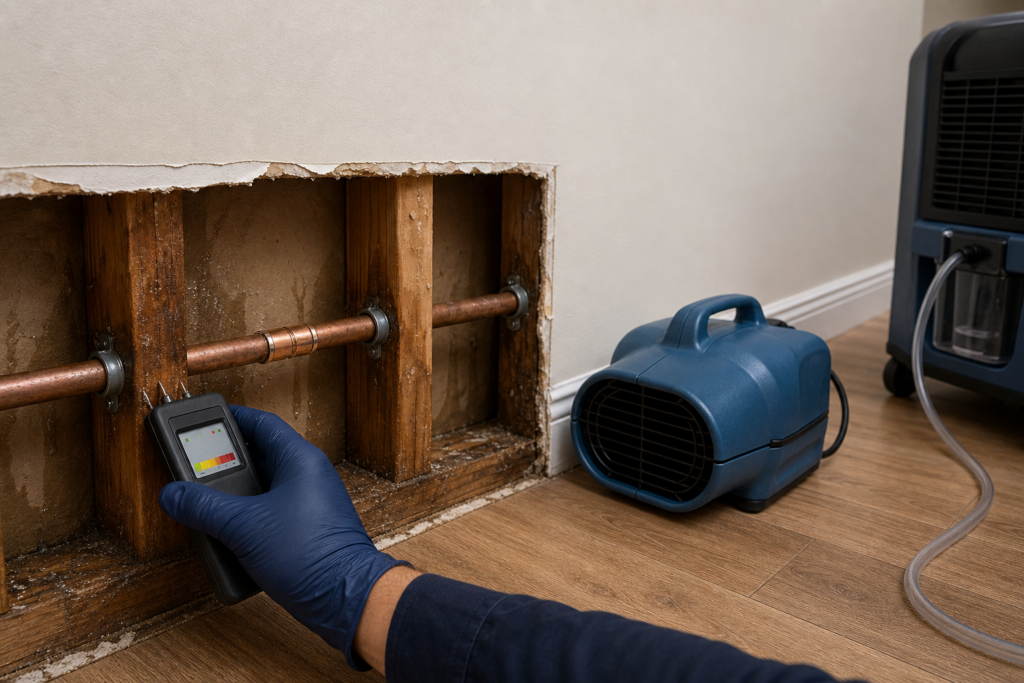





A wall is not proven dry just because the stain stopped spreading, the paint feels dry, or the room no longer smells damp. The plumbing source must be stopped, and the drywall, insulation, framing, and concealed cavity must be evaluated as separate materials.
Reliable verification usually combines a moisture map, readings from the affected materials, comparisons with similar dry areas, and progress measured over time. There is no single moisture percentage or number of drying days that works for every wall.
A Dry Surface Can Hide Moisture Inside the Wall
The exposed surface often dries first because room air can reach it. Moisture behind paint, inside the gypsum core, against the back of the drywall, or within insulation does not have the same airflow.
Water can also move downward through the cavity and collect around a lower framing plate or baseboard. A small upper-wall leak may leave the visible stain looking better while wood or insulation remains damp below it.
Paint and wall coverings can slow evaporation. Dense insulation, multiple drywall layers, cabinets, tile, and other finishes can also make hidden materials dry differently. That is why touching one spot cannot represent the whole affected area.
Confirm That the Plumbing Leak Has Stopped
Drying cannot be verified while water is still entering the wall. The failed pipe, fitting, valve, fixture connection, or appliance supply must be repaired and checked under the conditions that previously produced the leak.
Watch for renewed staining, dripping, running-water sounds, pressure changes, or moisture that returns after a fixture is used. A safely visible water meter may provide another clue when every intended water use is off, but meter movement cannot identify the source by itself.
If the damage began with a supply-line failure, professional water line repair and replacement may be part of stopping the source. Broader residential plumbing service may be appropriate when the failed component has not been isolated.
Do not repaint or close the wall until the source repair and drying assessment agree. A wall that becomes wet again needs another source check, not a new coat of paint.
Safe Clues a Homeowner Can Record
Homeowners can help document the drying pattern without opening the wall. Take dated photographs from the same angle and note whether the stain, swelling, or paint condition changes. Record when drying equipment is operating and whether moisture reappears after plumbing use.
Useful observations include:
- A baseboard that remains swollen or separates from the wall
- Soft, crumbling, blistered, or discolored drywall
- Flooring that lifts or feels different near the wall
- Condensation or dampness that returns after appearing to improve
- A musty odor that persists or becomes stronger
- A cool area that remains different from the surrounding wall
These signs justify further evaluation, but none proves how wet the cavity is or whether microbial growth is present.
Do not drill holes, remove outlet covers, pull insulation, or cut drywall to investigate. Hidden pipes and electrical wiring may be close to the surface. Keep away from wet electrical equipment, and do not move or shut down restoration equipment unless the responsible technician directs you to do so.
How Restoration Technicians Check Drying Progress
A drying assessment begins by mapping the affected area. Readings are taken across the visible damage and beyond it so the boundary can be compared with material that appears unaffected.
A non-invasive moisture meter can screen a larger drywall area without puncturing the finish. It is useful for finding patterns, but metal fasteners, pipes, dense materials, coatings, and construction differences can affect the response. A higher reading is a reason to investigate, not automatic proof of the exact moisture level or source.
Pin-type readings may be used where the material and access make them appropriate. They can help assess wood framing or compare different depths, but the meter setting and material matter. A number obtained from wood cannot be treated as the same measurement as a number from drywall.
Thermal imaging can reveal temperature patterns that may correspond with evaporation or wet materials. It does not see moisture directly. Air-conditioning, sunlight, insulation gaps, air leaks, and hot or cold plumbing can produce similar temperature differences.
Technicians may also track room temperature and relative humidity because the surrounding air affects evaporation. A comfortable room-humidity reading does not prove that insulation or a wall cavity is dry.
The strongest conclusion comes from several pieces of evidence agreeing: the leak is stopped, the moisture boundary is understood, affected materials are approaching suitable comparison conditions, and readings are no longer remaining elevated or moving in the wrong direction.
Why There Is No Universal Dry Number
Drywall, wood framing, insulation, plaster, masonry, flooring, and cabinets do not share one normal reading. Meter models may also report different scales. Wood species, material density, coatings, temperature, salts, and nearby metal can influence the result.
A technician can establish a practical comparison by checking the same type of material in an unaffected area under similar indoor conditions. Readings from the affected area can then be compared with that reference and monitored as drying continues.
One low reading at one location is not enough if nearby material remains elevated. Ask where readings were taken, which materials were tested, what comparison areas were used, and whether the results changed over time.
American Home Repair Services’ summary of IICRC water-damage standards describes inspection, extraction, structural drying, and verification as separate parts of restoration. The practical takeaway is that verification should be treated as its own step rather than assumed from appearance.
Drywall, Insulation, and Framing Need Separate Attention
The painted face of drywall may dry while its core or back remains damp. Wood studs and lower framing plates can retain moisture after the surrounding surface improves. Insulation may hold water against both materials or limit airflow through the cavity.
A meter used only on the room-facing surface may not fully describe those hidden conditions. The restoration plan should account for what became wet, which materials remain in place, and whether access is needed for inspection or drying.
Wet insulation does not always have the same response. Its type, condition, water source, and accessibility influence whether it can be evaluated in place or needs professional removal. Homeowners should not pull it out through an improvised opening, especially when electrical wiring or contaminated water may be involved.
What to Verify Before Repainting or Closing the Wall
Before new drywall, insulation, primer, paint, trim, or cabinets cover the area, confirm that:
- The plumbing source was repaired and checked for continued leakage.
- The full moisture boundary was evaluated, not only the center of the stain.
- Drywall, framing, insulation, and other affected materials were considered separately.
- Readings were compared with suitable unaffected materials or another appropriate project-specific reference.
- More than one location was checked where the affected area extends through the wall.
- Drying progress was documented over time instead of relying on one isolated reading.
- Hidden lower areas, such as sill plates and material behind baseboards, were not overlooked.
- Contaminated water, damaged material, or suspected microbial growth received the appropriate professional evaluation.
- The remaining surfaces are sound enough for the planned finish or reconstruction.
If an insurance claim is involved, keep photographs, plumbing-repair records, drying logs, equipment dates, and final readings. Ask the insurer what documentation it requires. A contractor’s records do not guarantee coverage or claim acceptance.
Drying Time Alone Is Not Proof
Two walls exposed to similar leaks can dry at different rates. Water volume, exposure time, wall construction, insulation, indoor humidity, airflow, temperature, equipment placement, and access all affect the result.
A fixed number of hours or days cannot replace material readings. The calendar can show how long drying has been underway, but the condition of the materials determines whether the wall is ready for repair.
Does a Dry Wall Mean There Is No Mold?
A current dry reading does not guarantee that microbial growth is absent or that it could not have developed earlier. Drying verification answers a moisture question at the time of inspection. It does not reconstruct every condition that existed after the leak.
Do not disturb visible growth or rely on color and odor to identify it. Persistent odor, visible suspect growth, contaminated water, or materials that stayed wet for an unknown period deserve professional evaluation before the cavity is closed.
When the Area Needs Immediate Attention
Seek prompt help when water is still spreading, a ceiling or wall is bulging, sewage or other contaminated water is involved, or wet materials are near outlets, wiring, appliances, or an electrical panel.
Do not touch electrical equipment in a wet area or stand beneath a sagging ceiling. If the correct homeowner-operated water shutoff is safely accessible and familiar, shutting off the water may limit damage. Otherwise, leave the unsafe area and wait for qualified help.
What to Expect From Professional Drying Verification
Professional water damage restoration in Encino should begin with confirmation of the water source and a map of the affected materials. The technician can explain which readings are elevated, which comparable areas are being used, and how the drying pattern changes during monitoring.
Equipment may be adjusted as conditions change. When drying is complete, the final assessment should identify the materials checked, the locations tested, and any area that still needs removal, access, or further evaluation.
The result should be a property-specific decision about whether the wall is ready for repair—not a conclusion based only on touch, appearance, one device, or elapsed time.
Frequently Asked Questions
Can a Homeowner Moisture Meter Prove That a Wall Is Dry?
It can help screen for differences, but one reading cannot prove that the entire wall cavity is dry. Meter type, material setting, test location, nearby metal, and comparison readings all affect interpretation.
Can I Paint Once the Stain Feels Dry?
Wait until the leak is stopped and the affected materials have been evaluated. Paint can hide a stain without resolving moisture held behind the surface.
Should I Open the Wall to Check the Insulation?
Do not cut or drill into the wall without knowing where plumbing and electrical wiring run. A professional can decide whether controlled access is necessary based on moisture evidence and safety conditions.
Can Thermal Imaging Confirm That Moisture Is Gone?
No. Thermal imaging shows temperature differences, not moisture itself. It is most useful when interpreted with meter readings, inspection findings, and knowledge of the wall construction.
Confirm the Wall Is Dry Before Repairing It
If an Encino wall still shows staining, swelling, odor, or uncertain moisture after a plumbing leak, do not cover the area based only on appearance. A material-specific assessment can identify what has dried, what still needs attention, and whether the cavity is ready for repair.
Contact American Home Repair Services to request a water-damage drying assessment and discuss the next step for the affected wall.