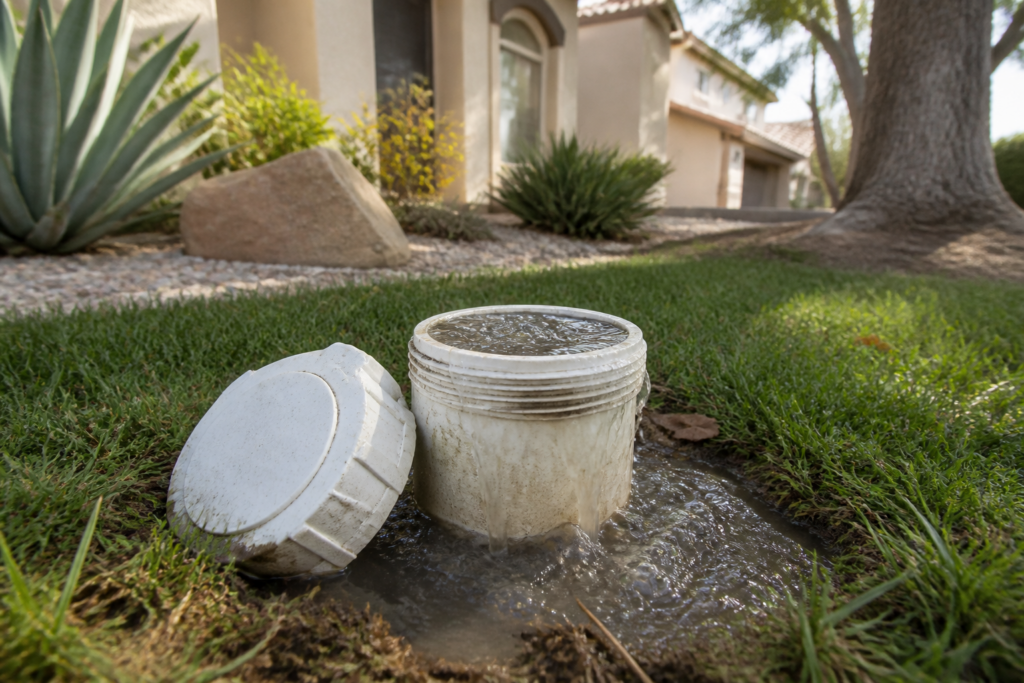





An outdoor sewer cleanout overflowing in the yard usually means wastewater cannot move normally through part of the sewer path and is escaping at an available access point. A restriction farther downstream in the main sewer line is a common possibility, but the overflow alone does not prove whether the cause is grease, debris, roots, a shifted pipe, structural damage, or a condition beyond the property connection.
Stop using water inside the home as soon as you notice the overflow. Do not flush toilets, run faucets, take showers, start laundry, or use the dishwasher to see what happens. Keep children and pets away from the wet area. Avoid direct contact, and do not approach standing water near receptacles, landscape lighting, air-conditioning equipment, or other electrical sources. Leave the cleanout cap exactly as you found it; opening, tightening, or probing a loaded fitting can release more wastewater or redirect a backup into the home.
Why Wastewater Can Rise at a Yard Cleanout
A sewer cleanout is a capped access fitting connected to the building drain or sewer lateral. A plumber may use it to inspect, clear, or test the line without opening a wall or removing a fixture. The fitting may stand slightly above grade, sit inside a protective box, or be partly hidden by landscaping.
Under normal conditions, wastewater passes through the pipe below the cap and continues toward the property connection. If that path is restricted, water and waste can collect behind the obstruction. The level may rise until it reaches a lower opening. A loose, cracked, missing, or displaced cleanout cap can become the place where that backed-up flow appears.
The cleanout location provides a useful clue, but it is not a diagnosis. More than one cleanout may serve the property, and fittings can face different directions. The visible overflow does not show how far away the restriction is or whether the pipe itself is damaged. A controlled inspection is needed before deciding what the line requires.
Stop Adding Water and Keep the Area Clear
Every toilet flush, shower, sinkful, and appliance discharge adds water to the same drainage system. If the main path cannot carry that volume, more wastewater may spill into the yard or rise at a low indoor fixture. Ask everyone in the home to pause water use until the line has been evaluated.
Keep foot traffic, pets, toys, gardening tools, and lawn equipment away from the affected soil. Do not hose the area toward the street, sidewalk, neighbor’s property, or a storm drain. If the spill has reached a public walkway or another area that cannot be safely isolated, mention that when requesting service.
Do not step into wet ground to unplug or operate electrical equipment. If wastewater is near a receptacle, extension cord, landscape-light connection, pool equipment, or an exterior disconnect, keep your distance and report the location. The sewer problem and the electrical exposure need to be approached without adding another hazard.
Main-Line Symptoms Differ From One Isolated Fixture
An isolated fixture clog usually affects one sink, tub, shower, or toilet while other fixtures continue draining normally and the outdoor cleanout remains dry. A main sewer restriction can affect several fixtures because they all discharge into a shared path. Possible clues include toilets gurgling when another fixture drains, wastewater rising in a low shower or tub, several drains slowing together, or the cleanout overflowing when a toilet, washing machine, or multiple fixtures send a larger volume downstream.
Those patterns are useful, but do not recreate them. A cleanout that stopped overflowing after water use paused may still have a restriction waiting behind the cap. One slow fixture does not rule out a larger problem, and several symptoms can occur at the same time for different reasons.
Professional sewer line repair and replacement evaluation can trace the shared flow path and separate an accessible obstruction from a physical pipe condition. The goal is to locate the affected section before choosing a cleaning or repair method.
Safe Observations Can Help Without Testing the Line
Record only what you can see from a safe, dry location. A short video or photograph taken without stepping into the affected area may help show the water level, cap position, and extent of the spill. Useful details include:
- What time the overflow was first noticed.
- Whether a toilet, shower, laundry cycle, dishwasher, or several fixtures had been used shortly beforehand.
- Whether more than one indoor drain had already become slow, noisy, or backed up.
- Whether the outdoor flow slowed after everyone stopped using water.
- Whether the problem has happened before and what service was performed then.
- Whether the event followed rain or occurred during dry weather.
- Whether nearby properties are reporting similar drainage trouble.
- Whether the cap looks intact, tilted, cracked, or already missing.
- Whether paper, grease-like residue, soil, or only cloudy water is visible without approaching it.
- Where the fitting sits in relation to the house, street, and any other cleanout.
Timing after rain can matter in Encino, but it does not prove that stormwater entered the sewer or that a public main is responsible. Rain may coincide with saturated soil, an existing defect, or unrelated household flow. Likewise, visible paper does not reveal what is blocking the pipe; it may simply be normal waste held behind a different obstruction.
Several Conditions Can Restrict the Sewer Path
Accumulated grease, unsuitable disposable products, paper, and other debris can narrow the line or collect at a joint. Roots can enter through a vulnerable connection and catch solids. Older pipe may have an offset, separated joint, low section, corrosion, crack, or partial collapse that reduces the usable opening. A damaged fitting or poor slope can also hold material and contribute to repeat backups.
None of these causes should be assumed from the yard alone. A nearby tree does not prove root intrusion. An older sewer is not automatically collapsed. A line that opens after cleaning is not automatically sound. The location, pipe material, clearing results, and an unobstructed view all matter.
A condition farther downstream can sometimes create similar symptoms. Whether the affected section is on a private sewer path or beyond the property connection depends on the actual layout, direction of flow, and local service boundary. The plumber can document where access and testing place the restriction. If the evidence points beyond the serviceable property line, those findings can support the appropriate next contact.
Do Not Open, Tighten, or Probe the Cleanout
A cap that appears loose can make the problem look like a simple fitting repair. Tightening it while the line is backed up may force wastewater toward a shower, tub, floor drain, or toilet. Removing it can release retained sewage toward the person standing over the opening. Striking or twisting an older fitting can crack the riser or connection below grade.
Avoid these actions while the condition is unresolved:
- Do not touch, remove, tighten, or replace the cleanout cap.
- Do not flush another toilet or run a hose to test the overflow.
- Do not pour drain cleaner, acid, bleach, enzymes, or another chemical into the cleanout or an indoor fixture.
- Do not mix products or add a second cleaner after one has already been used.
- Do not insert a rented cable, rod, garden hose, pressure nozzle, or improvised tool.
- Do not dig around the fitting or try to expose the pipe with a shovel.
- Do not pump or vacuum wastewater into the street, landscaping, or storm drainage.
Tell the plumber if any chemical, cable, hose, or other product was already used. That information can affect how the access point is opened and what protective steps are appropriate.
What a Professional Sewer Evaluation Checks
The first task is to understand the flow path and control access to retained wastewater. The plumber can inspect the cleanout, cap, riser, surrounding soil, and nearby fixtures; identify the likely direction of the sewer; and determine whether the line is holding water. A loaded cap should be approached with protective equipment and a plan for the material that may be behind it.
Depending on the findings, the evaluation may include:
- Identifying which fixtures and pipe sections feed the affected cleanout.
- Checking whether the restriction is upstream or downstream of the accessible fitting.
- Selecting a clearing method suited to the pipe size, material, access, and suspected obstruction.
- Restoring enough controlled flow to test the line without recreating the yard overflow.
- Performing a sewer camera inspection after standing water and loose debris no longer block the view.
- Looking for roots, offsets, cracks, separated joints, bellies, corrosion, intrusion, or collapse.
- Documenting the location and extent of any visible defect before recommending repair.
A camera can provide valuable evidence, but it cannot see clearly through opaque backed-up water or heavy debris. Clearing retained material may need to come first. The follow-up view should look for why the obstruction collected rather than treating restored flow as proof that the underlying condition is gone.
Cleaning May Restore Flow, but It Cannot Repair Damage
Professional drain cleaning may remove grease, debris, some root growth, or another obstruction from a structurally usable pipe. The appropriate method depends on the line and what the technician finds. More force is not always better, especially when pipe condition is uncertain.
Cleaning cannot correct a collapsed section, severe offset, separated joint, failed fitting, or pipe segment that no longer provides a stable path. If a defect keeps catching material, repeat clearing may restore flow temporarily without correcting the reason backups return.
Repair becomes part of the decision when inspection locates physical damage or another condition cleaning cannot resolve. The scope may be limited to one section when the rest of the line remains serviceable. A larger repair or replacement may be considered when damage is extensive, access is limited, or multiple sections have failed. The recommendation should follow the documented condition rather than the fact that the cleanout overflowed.
The cleanout itself may also need attention if the cap, adapter, riser, or connection is cracked or displaced. Repairing the fitting alone will not remove a downstream restriction, so the line still needs a controlled flow check before normal household use resumes.
Address Yard Contamination After the Flow Is Controlled
Stopping the overflow comes before cosmetic cleanup. Once the sewer path is controlled, the affected surface can be assessed based on how much wastewater escaped, where it traveled, and whether it contacted soil, mulch, porous materials, play equipment, a walkway, or the inside of the home.
Keep the area isolated until appropriate cleanup is complete. Do not assume sunshine, rain, or a garden hose makes the surface sanitary. A small contained spill on a service area presents a different cleanup problem than wastewater that crossed a sidewalk, entered a crawlspace, or soaked indoor materials. The existing sewage cleanup information for Encino properties explains why plumbing control and contamination cleanup may need to be coordinated.
Request Sewer Help Before Using Water Again
If a sewer cleanout is overflowing in your Encino yard, keep household water use paused and leave the fitting untouched. American Home Repair Services can inspect the cleanout and connected sewer path, determine whether controlled clearing and camera inspection are appropriate, and explain whether the evidence supports cleaning, a focused repair, or broader sewer work.
Contact American Home Repair Services and describe where the cleanout is located, what was running before the overflow, whether indoor fixtures are affected, and whether the spill has reached a walkway or electrical equipment. Those observations can help the team prepare without asking you to reopen or test the line.